
I was at a Chamber breakfast last month when someone asked if Augusta businesses were “ready for AI.” The question assumes it hasn’t arrived yet. It has. It’s just not wearing a name tag.
Augusta small business AI automation is already running behind the scenes. A dental practice across town sends appointment reminders at 24 hours and again at 2 hours before your visit. A gym texts you back within 30 seconds when you call after hours. A landscaping company asks for a review seven days after finishing your yard. None of them call it “AI.” They just call it “not losing customers to preventable gaps.”
According to the US Census Bureau, about 18 to 20 percent of US employer firms now use AI in some business function. The SBA Office of Advocacy reports that small businesses have closed the gap with large enterprises over the past 18 months. In February 2024, large firms used AI at nearly twice the rate of small businesses. By August 2025, small businesses caught up. The gap nearly disappeared.
The thing is, most Augusta small business ai automation doesn’t look like what the headlines describe. It looks like a text message that shows up at the right time.
The Appointment Reminder You Don’t Think About
Let’s start with the most invisible one: appointment reminders. A dental office books you for a cleaning three months out. You get a text two days before, then another text two hours before. You show up. The system worked.
What you didn’t see: the reminder was written once, automated to fire based on appointment time, and sent without the front desk touching it. The dentist isn’t paying someone to call 40 patients tomorrow. The system handles it.
Research published in BMC Public Health analyzed dozens of studies on appointment reminder systems. SMS reminders showed effectiveness in reducing no-shows across multiple healthcare settings. The pattern holds outside healthcare too. A gym in Augusta that automates reminders for personal training sessions sees fewer no-shows than when they relied on trainers to remember to call.
This is AI in the boring, high-value sense. It reads a calendar. It fires a message at the right interval. It keeps the schedule full. No one writes a press release about it, but the difference between 30 percent no-shows and 10 percent no-shows is the difference between profit and loss for a service business.
The After-Hours Text-Back
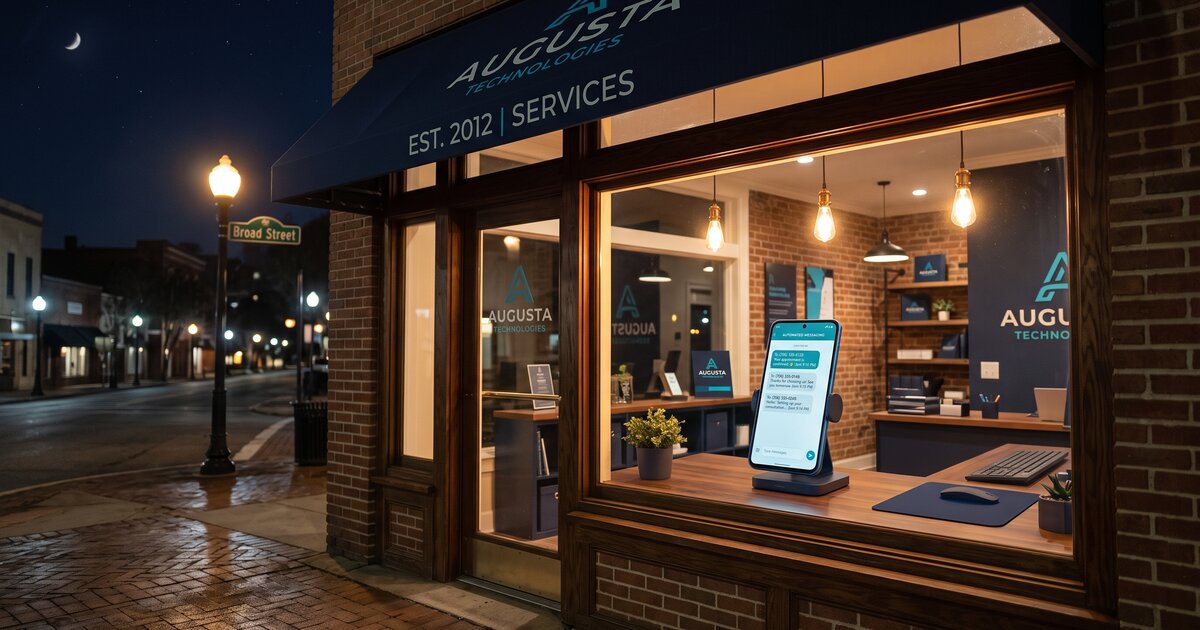
Here’s the other one that feels invisible until you’re the customer: missed call text-back. You call a contractor at 6:15 p.m. because you just got home and noticed the fence is leaning. They don’t answer. Thirty seconds later, you get a text: “Hi, this is [Business Name]. We just missed your call. Need to schedule an estimate? Tap here: [link]. We’ll follow up first thing tomorrow.”
You tap the link. You book Tuesday at 10 a.m. The contractor gets a notification. By the time they check their phone at 7 p.m., the appointment is already on the calendar.
Without that text, you would have called the next name on Google. Most people do. The automation didn’t just capture the lead. It prevented the lead from becoming someone else’s customer.
This pattern works across Augusta: HVAC companies that get calls during installs, plumbers who are under a sink when the phone rings, gym owners in the middle of a class. The AI layer is simple. Call goes unanswered, system fires a text within 60 seconds, includes a booking link or a “we’ll call you back” confirmation. The customer feels taken care of. The business doesn’t lose the lead.
I’ve watched this play out at my own business. When I was running the axe-throwing venue, I couldn’t answer the phone during league night. We were at capacity, music cranked, 30 people mid-competition. A call would come in, and I’d see it two hours later. By then, the caller had moved on. Once we automated the missed call text, we recovered about a third of those after-hours inquiries. That’s pipeline we used to just lose.
The Review Request That Lands at the Right Moment
The third automation that Augusta businesses use without talking about it: review requests. You hire a landscaper. They finish the job. Seven days later, you get a text: “Hey [Name], thanks for trusting us with your yard. If you’re happy with how it turned out, we’d love a quick review. Here’s the link: [Google review URL]. If anything wasn’t right, just reply here and we’ll make it right.”
Most people who were happy leave the review. Most people who weren’t happy reply instead of posting publicly. The business gets more 5-star reviews and fewer 1-star surprises.
BrightLocal’s 2026 consumer survey found that 97 percent of consumers read reviews for local businesses before choosing one. Expectations are climbing. Thirty-one percent of consumers now require a business to have 4.5 stars or higher, up from 17 percent just a year earlier. That’s a steep filter. A business in Augusta competing for local customers needs reviews to clear that bar.
Automating the request solves two problems. First, you actually ask. Most businesses forget or feel awkward about it. Second, you ask at the right time. Seven days after the job is the sweet spot. The customer remembers the experience, but they’re not annoyed by an immediate request. Timing matters more than the words.
A gym here in Augusta went from about 10 reviews a year to over 80 after automating review requests tied to membership milestones. Thirty days in, 90 days in, six months in. Each milestone triggered a request. Most members said yes. The gym’s star rating climbed. More people walking by saw the rating and came in for a trial. The loop compounds.
It Doesn’t Feel Like AI Because It Feels Like Service
The reason Augusta small business ai automation doesn’t feel like “AI” is because it doesn’t announce itself. It feels like good service. The text arrives when you need it. The reminder keeps you from missing an appointment. The follow-up happens without you having to chase someone down.
That’s the point. AI that works doesn’t feel like AI. It feels like the business is paying attention.
The gap between small businesses and big businesses on this has nearly closed, according to SBA data. That’s not because small businesses suddenly got a bigger tech budget. It’s because the tools got simpler and cheaper. A dental office can set up automated appointment reminders in an afternoon. A contractor can turn on missed call text-back for $30 a month. A gym can automate review requests without hiring a marketing team.
None of it requires a data scientist. Most of it runs on the same systems small businesses already use for scheduling, email, and text messaging. The AI layer sits on top, mostly invisible, mostly doing one job well.
What surprises me is how many Augusta businesses still don’t use it. Not because they’re against technology. Because they don’t realize it exists or think it’s only for bigger operations. That assumption costs them customers every week.
A missed call is a lost lead. A no-show appointment is a lost hour. A customer who would have left a review but never got asked is a lost star rating that someone else will see next week.
The automation fixes all three. Quietly. Without hype.
It’s already here.
Running a small business in Augusta and curious what automation could handle for you without adding complexity? Book a 30-minute strategy call. We’ll walk through what’s possible, what’s worth it, and what you can skip.