
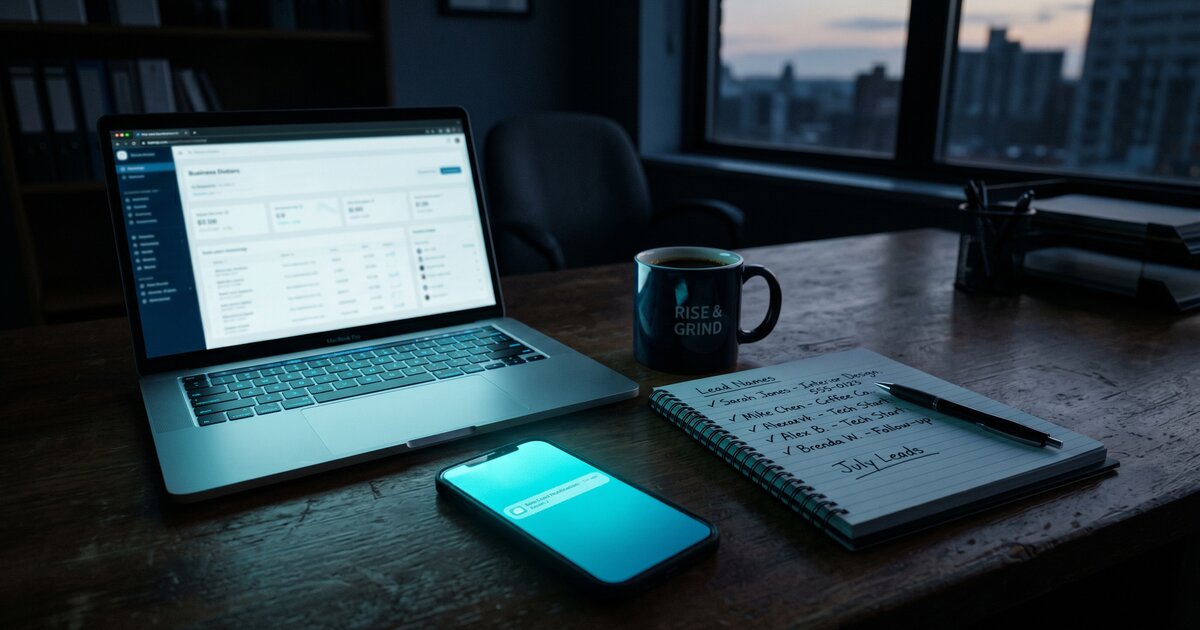
It is 9:14 on a Tuesday. The shop is open. You are elbow-deep in an order that has to ship today, the printer is jammed, and your phone just buzzed. A new lead. Someone filled out the contact form on your website. Maybe a quote request. Maybe a job worth twelve hundred bucks. You see the notification. You think, I’ll get to that right after I fix this printer.
You don’t get to it. Not for two hours. By the time you do, they have already booked someone else.
This is the quiet way small businesses bleed revenue. Not in big lost contracts. In the small business lead response time gap between when someone reaches out and when you finally reply. And the gap matters more than most owners realize.
Five minutes is the difference between a sale and a “we went with someone else”
There is a 2011 study out of Harvard Business Review by Oldroyd, McElheran, and Elkington called The Short Life of Online Sales Leads. They looked at 2.24 million sales leads across dozens of companies. Then they timed how long it took for the businesses to actually respond.
The finding was brutal. Companies that responded within an hour were nearly seven times more likely to qualify the lead than companies that waited even one additional hour. Companies that waited 24 hours or more were 60 times less likely to qualify a lead than the ones who jumped on it inside the first sixty minutes.
Sixty times. Not 60% less. Sixty times less.
And it gets sharper. Subsequent research from InsideSales (now Verse.ai) found that responding within five minutes makes you 21 times more likely to qualify the lead than waiting just ten minutes. Five to ten. Not five to a day. Five to ten. That is the slope you are working against when the form comes in.
Now think about your average Tuesday. Be honest. How fast are you actually getting back to people who fill out your form? Not the times you happened to be at the desk. The average. Across a week. Including the ones that came in while you were running payroll, on a job, picking up the kids, or asleep.
If you are like most small businesses, the answer is “way slower than I think.” A 2025 analysis from Ambs Call Center found that small businesses only answer 37.8% of incoming calls. The other 62% go to voicemail or get nothing back at all. And 85% of those callers do not try a second time. They just call the next listing.
The math is uglier than you think
Let’s put real numbers on this. Say you get 20 leads a week through your phone and website combined. A reasonable conversion rate for a small service business is around 25%. So out of 20 leads, you would book five jobs a week.
But here is what is actually happening. About half of those leads are arriving when you can’t respond inside an hour. Maybe you are on a job. Maybe you are sleeping. Maybe it is Sunday. Per the HBR data, that delay alone makes those leads roughly seven times less likely to qualify. So instead of converting at 25%, they convert at something closer to 3-4%.
Run the math. Of your 20 weekly leads, maybe 10 hit you fast enough to convert at 25% (2.5 jobs). The other 10 convert at 3-4% (call it 0.4 jobs). You are at less than three jobs a week, when you could be at five. That gap, over a year, is the difference between a decent year and a great one.
And those are just the form-fills. The missed calls are worse. Industry data shows missed calls cost small service businesses $300 to $1,200 per missed call depending on the trade. Home services on the high end. Professional services in the middle. Even retail averages around $100 a call. If you miss four calls a week and you are a plumber, that is roughly twenty thousand dollars a year walking to a competitor who picked up.
It was working a different way for me in 2017, when I was running an Escape Room and Axe Throwing venue in Augusta. I would see a corporate-event request hit my inbox at 3pm on a Thursday. I would think, I’ll send pricing tonight after we close. By the time I sent the pricing at 11pm, half the time the prospect had already booked somewhere else. I could feel the money leaving the building.
What “speed” actually looks like when there is only one of you
Here is the thing nobody likes saying out loud. You are not slow because you are bad at your job. You are slow because you are running the entire business yourself, and human attention is a finite thing. Twenty years in the Army taught me that command-and-control breaks down when one person is on every radio at once.
You can’t out-hustle this. You can’t just promise yourself you will check the inbox more often. You will check it for a week, you will book one extra job, you will feel great, and then on the second Tuesday a customer will need something complicated and the inbox will sit for six hours again. Hustle does not scale. Systems do.
So what does a system look like for a one-person shop or a five-person shop where everyone is wearing four hats? In practice it is two pieces:
- Instant acknowledgement. The moment a form is submitted or a missed call happens, the prospect gets a text or email back within seconds. Not a generic “we got your message.” A real, personalized response with the answer to the obvious question (pricing range, scheduling availability, next step) and a calendar link they can click. That alone catches you up to the 5-minute rule on autopilot, no matter what you are doing when the lead arrives.
- Smart follow-up. If the prospect does not respond in 24 hours, the system sends one more nudge. Then a second one 48 hours after that. Then it stops, so you are never the business that pesters. Most owners do not follow up at all after the first try. Adding two automated follow-ups doubles your booking rate in most service businesses I have worked with.
I am not making the case that you should automate yourself out of the conversation. The opposite. The job of these systems is to hold the moment so that when you do get to it, the customer is still warm and the conversation has not died. You handle the actual quote, the actual close, the actual handshake. The system just makes sure they are still on the line when you get there.
In my own venue, when I added that pipeline back in 2025, my corporate-event conversion rate nearly tripled. Same leads. Same me. Just no more lost time between the form fill and the first touch. That was the first moment I understood what AI and automation could actually do for a small business. Not replace me. Hold the line until I could show up.
This is the gap Insomniac Smart CRM was built to close for Augusta small businesses. You answer the phone like you always have. You go on jobs. You sleep. The system answers the calls you miss, replies to forms in seconds, and nudges the prospects who go quiet. By the time you sit down to your own inbox in the morning, half the leads from yesterday are already booked. The other half are waiting for you to call them, because they are still warm.
You don’t need to be faster. You need to stop being the bottleneck.
Running a small business in Augusta and wondering what your real lead response time looks like? Book a strategy call for thirty minutes. No pitch deck, no pressure. I’ll show you the math on your own numbers.